
This summer has been brutal. But what we do next matters more…
I’ve tried really hard to stay upbeat about this summer.
I’ve tried to show the good bits, (because there are still good bits), and because constantly talking about how difficult farming is doesn’t exactly encourage anyone else to start doing it.
But I think there comes a point where I also have to be honest. This summer has been brutal.
We have had weeks of extreme heat and drought. Yes, we have finally had some rain, and I am incredibly grateful for every drop of it. But a few days of rain doesn’t undo months of drought.
It doesn’t bring back the crops that have already failed. It doesn’t refill the reservoir overnight. It doesn’t replace the winter feed we have already had to use. It doesn’t suddenly make the greenhouse cool enough to germinate the crops we should have planted weeks ago.
And it certainly doesn’t undo the exhaustion of trying to keep everything alive through it.
Market Garden
August should be one of the most abundant times of the year. The market garden should be bursting with food, but instead, we have had a sea of empty beds.
Crops have scorched. Others have bolted before we could harvest them. Seeds haven’t germinated. Transplants have struggled to establish.
Our reservoir has been frighteningly close to running dry. And the greenhouse, which normally gives us the advantage of extending our growing season, has become part of the problem. Temperatures have been so high that germinating and establishing the winter crops that should be going into the ground now has been incredibly difficult, if not impossible.
That means this drought doesn’t end when it rains. What happens in the market garden today affects what is available weeks and months from now. If we miss a sowing window now we can’t just catch up next week so we could still be feeling the effects of this summer in winter and into spring.
We have estimated that at points we have been putting in perhaps ten times the work for around 75% less yield than we would expect.
We still have to weed the beds, sow the seeds, transplant, irrigate, only with far less food at the end of it.
Livestock
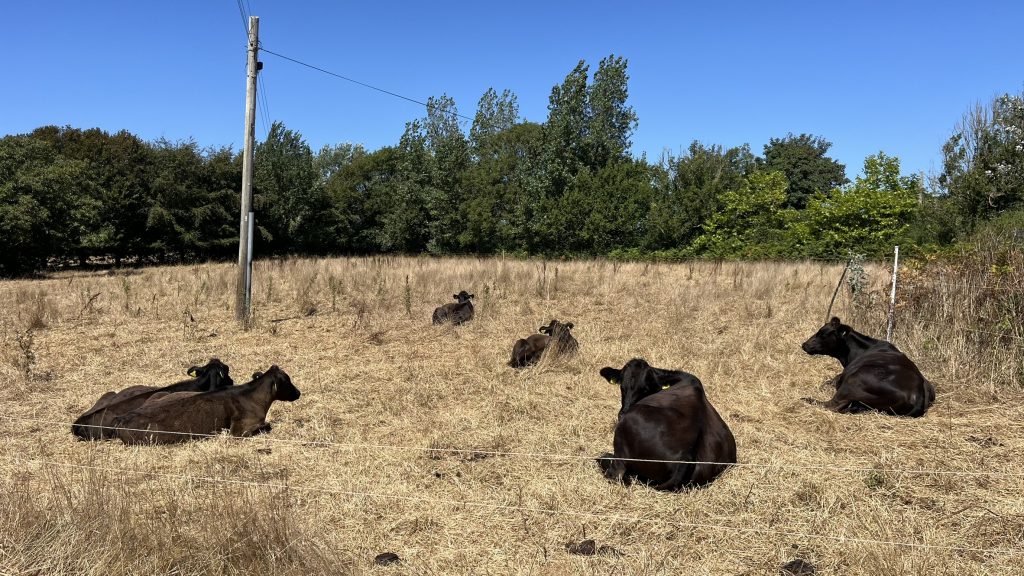
The cows should be moving regularly onto fresh pasture. Instead, they have been static because the grass simply hasn’t been growing fast enough to recover. If we keep moving the cows onto drought-stressed pasture, we risk damaging the grasses further. So we have had to protect the land and start feeding the cows their winter feed…In August!
That creates another problem further down the line. Every bale we feed now is a bale that isn’t available in January.
The chickens have had to remain static too, because moving their system across drought-stressed ground would cause more damage. But chickens don’t understand drought management. They get bored and they escape. We get them back in and they escape again.
And suddenly jobs that should take minutes are taking hours.
Pigs can’t sweat effectively, so keeping them cool in extreme heat becomes a welfare priority. Water drinkers and wallows that might normally be filled once have sometimes needed filling multiple times a day.
Everywhere we turn there is another job, another problem, another thing that needs water, another thing that needs money, another thing that needs time.
And this isn’t just happening to us
It’s not just Guernsey. Across Europe and further afield, farmers are dealing with the same extremes.
In France and other parts of Europe, extreme heat and drought have hit key growing regions hard. That doesn’t just stay in the fields, it moves through the food system. Lower wheat and grain harvests can mean more expensive bread, pasta and cereals. When rivers run low, it can also disrupt transport routes and irrigation, making it harder to move and grow food efficiently. Wildfires add further pressure by damaging farmland and reducing grazing areas, which again feeds into higher costs for meat and dairy. All of this eventually lands in the same place: less choice, higher prices, and more pressure on the food we rely on every day.
This matters to Guernsey because we import around 98% of the food we consume…
That means our food security isn’t just affected by what happens in our fields, it’s affected by what happens in fields in France, Spain, the UK and much further away. A crop failure thousands of miles away can eventually become a price increase or shortage on a shelf here.
And the weather system is not standing still.
El Niño is now developing strongly in the Pacific and is expected to intensify through the autumn.
El Niños effects vary enormously around the world. It shifts global temperature and rainfall patterns, increasing the likelihood of drought in some regions, heavy rainfall in others and further disruption to agricultural production.
So after the summer we have just experienced, we are looking towards autumn and winter knowing that global weather patterns remain highly unsettled and unpredictable.
The consequences of 2026 aren’t necessarily going to finish now it has started raining.
The Value of Food
This year, we have all worked longer to produce less. Our costs increase while our yield falls.
And yet there is still a widespread expectation that food should be cheap, regardless of the reality of what it actually takes to produce it.
In many jurisdictions, governments recognise food production as something worth protecting and provide structured support to the people producing it.
Jersey has a Rural Support Scheme providing direct financial support to its agricultural sector. In Guernsey, that wider support for food production is largely absent.
We are asking people to build businesses producing something every single person needs, while taking almost all of the risk themselves.
This summer has shown us just how vulnerable that model is. But it has also strengthened our conviction that what we are building matters.
So what do we do?
Now that I have got that off my chest, we look forward and we adapt.
We are now looking at the farm completely differently, with fresh eyes and more motivation than ever. We are not asking how we recover from the summer of 2026, but asking how we design a farm that can function if summers like this become more common.
Looking at water storage, better irrigation systems, more shade, different crop varieties, sowing dates and crop plans, different grazing strategies, more resilient pasture…
We are looking at infrastructure designed for both extreme heat and extreme rainfall. And probably plenty of things we haven’t even thought of yet.
The farm we need for the next twenty years may look very different from the farm we thought we were building five years ago.
And that’s fine, regeneration is about responding to the system in front of you, not stubbornly trying to recreate the one you used to have.
But it isn’t just farmers who need to adapt.
Guernsey needs to think about food differently
We import around 98% of what we consume.
For decades, that has worked. The boats arrive, the supermarket shelves fill up, food appears.
And because that system works so efficiently, it creates the illusion that food security isn’t really something we need to worry about.
But our food doesn’t magically appear on those boats. Someone has to grow it. Somewhere there is a field, a farmer, water, soil, labour and weather behind everything we eat.
And many of those places are now experiencing the same pressures we are. Our global food system is incredibly sophisticated, but sophistication isn’t the same thing as resilient.
If the regions we depend upon are simultaneously dealing with drought, flooding, crop failures, fires, rising costs and increasingly unpredictable seasons, relying almost entirely upon that system starts to look like a vulnerability.
That doesn’t mean that Guernsey needs to grow everything it eats. We physically couldn’t. Nor does food security mean shutting ourselves off from imports.
It means building enough local capacity that we are not almost entirely dependent on somebody else. The great thing is that a thriving local food system has benefits above and beyond food security.
- Healthy nutrient dense food produced on our doorstep
- More money circulating within the local economy
- Productive use of Guernsey’s agricultural land
- Skilled jobs and viable careers in farming and horticulture
- Opportunities for new and young farmers
- Fresher food with shorter supply chains
- Better connection between people and where their food comes from
- Healthier soils and greater biodiversity when land is managed well
- More control over the standards under which our food is produced
- Stronger relationships between farms, restaurants, schools, retailers and communities
- Knowledge and skills remaining on the island rather than disappearing with each generation that leaves farming.
Food production doesn’t have to be a charitable either, it can be a thriving local industry. But if we want to rebuild that industry quickly enough to matter, we need some joined-up thinking.
Government. Land. Planning. Water. Infrastructure. Training. Routes to market. Procurement. Education. Finance. Investment. Support for new entrants.
They all connect.
We have lots of ideas about what that could look like, but that’s a conversation for another day. For now, I think the important thing is that we start having the conversation at all, because food security isn’t something we can start worrying about when supermarket shelves are empty. By then, we are too late.
There are challenging years ahead. I don’t think pretending otherwise helps anyone, but I also don’t think the answer is despair.
The answer is ambition, flexibility, and collaboration. It’s learning from the brutal summer we have had and to let go of old thinking.
Its time to adapt.
Sasha, August 2026